01 / PROBLEM
Answers from shop data, not assumptions.
Customers may ask whether an item is in stock, what is happening with an existing order, or what the return policy allows. A language model alone should not invent inventory or order details, and order placement needs a clear confirmation step.
02 / SOLUTION
Connect the chat agent to explicit business tools.
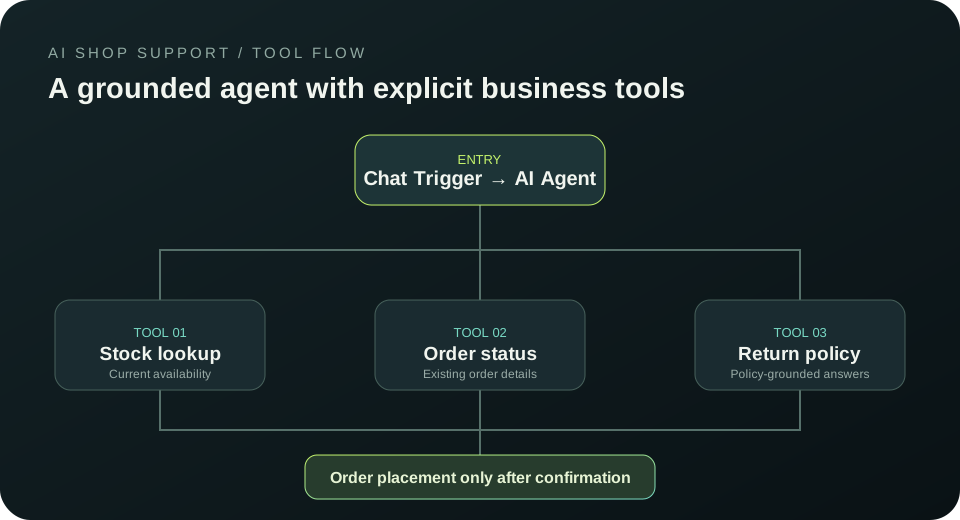
The n8n workflow uses a Chat Trigger connected to a LangChain AI Agent. The agent can call defined tools for stock lookup, order status, return-policy information, and order placement. The goal is to keep business facts in the connected data and workflow logic instead of treating the model as the source of truth.
03 / ARCHITECTURE
Language apart from business operations.
04 / DATA & ENVIRONMENT
Workflow data in a local container.
The recorded project environment uses Docker Compose 5.5.1 with a PostgreSQL container named n8n-postgres, a pgvector:pg16 image, and a database named n8n_projects. This page identifies the database setup as part of the project environment; it does not claim a specific retrieval benchmark or embedding quality result.
The agent tools define which business operations can be requested. Order placement is not treated as a casual text response: the workflow requires confirmation before the action proceeds.
05 / GUARDRAILS
Make uncertainty and confirmation visible.
Tool-backed facts
Stock and order questions are routed to the appropriate tools rather than answered from model memory.
Explicit policy source
Return-policy questions use a policy lookup tool rather than relying on a general answer.
Confirmation before order
The workflow asks the customer to confirm the order details before proceeding with placement.
Honest project scope
No pass-rate, latency, or production-usage metrics are claimed on this page.
06 / SCOPE & NEXT STEPS
A workflow project, not a live service.
This case study summarizes the configured agent and local environment. It does not claim public production deployment, a published code repository, or measured business outcomes. Future validation should include explicit test conversations for unknown products, missing order IDs, insufficient stock, policy edge cases, and unconfirmed order attempts.